





Blog
2026 Top Types of Rapid Action Doors for Global Buyers
Global buyers entering the 2026 market need more than a catalog of fast-opening equipment. Rapid Action Doors differ in speed, sealing, safety systems, construction, and maintenance demands. A cold-storage warehouse needs different protection from a dusty manufacturing line or a busy logistics hub.
Industry specialist Dr. Jan van der Velden observes, “A high-speed door is production equipment, not merely a building closure.” That practical view matters. Every opening affects temperature control, airflow, worker movement, energy use, and daily output. The best choice begins with the operating environment, not the lowest purchase price.
This guide examines the leading types of Rapid Action Doors expected to attract global buyers in 2026. It considers fabric roll-up doors, high-speed spiral doors, folding doors, insulated models, cleanroom doors, and specialized freezer solutions. Each type has strengths, limits, and installation conditions that deserve close attention. Some doors promise impressive cycle speeds, yet their real performance depends on traffic frequency, wind exposure, sensors, and service quality.
Small details matter. A reinforced bottom edge can reduce impact damage. A heated track may prevent freezing in a cold room. Clear viewing panels can improve visibility near forklifts. Still, no ranking can fit every facility. Product data may look precise, but local installation skills sometimes decide the final result. Buyers should question unclear specifications, verify compliance requirements, and request service records before committing. The perfect door does not exist. The suitable door does.
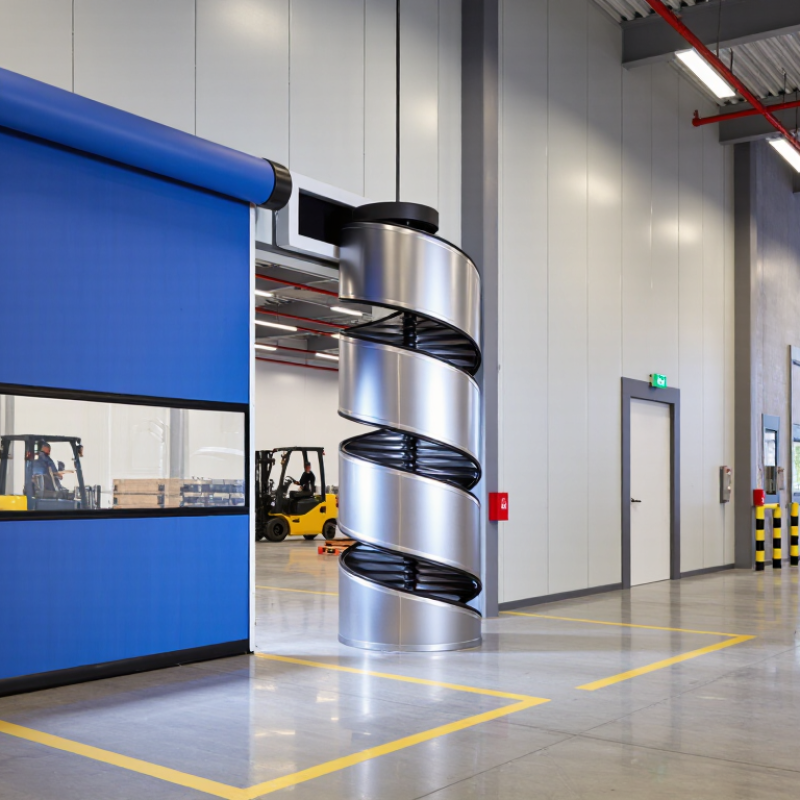
What Rapid Action Doors Are and Why Global Buyers Use Them
Rapid action doors are high-cycle industrial doors designed to open and close quickly. They help control movement between working areas, storage zones, and outdoor spaces. Unlike conventional doors, they reduce the time an opening remains exposed. Most designs use flexible curtains, while others use insulated panels or rigid sections. The right structure depends on traffic, temperature, pressure, and impact risks.
Global buyers use rapid action doors to improve workflow and environmental control. In a chilled warehouse, quick closure helps limit cold-air loss and condensation. At a dusty production line, the door can reduce airborne particles entering clean areas. At a loading dock, faster operation may shorten waiting time for forklifts and workers. Energy savings can also matter in facilities with frequent daily traffic. Small time savings become significant over several thousand cycles.
Selection still requires careful site evaluation. Buyers should check clear opening size, cycle frequency, wind exposure, safety sensors, and replacement-part availability. Door speed alone is not enough. An oversized system may waste money and complicate maintenance. Poorly placed sensors can cause unnecessary stops. In some projects, the initial specification looks impressive but performs poorly because traffic patterns were misunderstood. That lesson is easy to overlook. Reliable purchasing decisions come from measured site data, trained installation, and a realistic maintenance plan.
2026 Top Types of Rapid Action Doors for Global Buyers
Rapid action doors are designed for frequent opening and closing in industrial, commercial, logistics, food-processing, and cold-storage environments. Their high operating speed helps reduce air exchange, protect controlled areas, improve workflow, and support energy efficiency.
The chart compares representative maximum opening speeds commonly specified for major rapid action door types. Actual performance varies by door size, control system, safety configuration, wind exposure, temperature, and installation conditions.
Main Types of Rapid Action Doors Available in 2026
Rapid action doors in 2026 are available in several practical designs, each suited to different traffic patterns and environments. High-speed roll-up doors use flexible curtains and compact drums. They fit warehouses, loading bays, and production areas with limited space. Their fast opening reduces air exchange and waiting time. However, curtain replacement may be necessary after repeated impacts.
High-speed folding doors use reinforced fabric panels that move sideways or fold upward. They work well in wider openings and areas exposed to wind. Sliding rapid doors offer broad access for vehicles and equipment. Their horizontal movement can be useful when overhead clearance is restricted.
Spiral doors use interlocking slats that coil above the opening. They provide stronger insulation and a cleaner appearance, though their initial cost is often higher.
Cold-storage facilities may require insulated rapid doors with heated guides and sealed bottom edges. These features help limit frost and temperature loss. Clean manufacturing areas often need smooth surfaces and easy-to-wash components. Fire-rated doors require separate certification and should never be selected from speed alone.
Site measurements matter. Buyers should check opening size, wind pressure, cycle frequency, safety sensors, power supply, and local compliance requirements. In real projects, door speed is sometimes overvalued. A slower model with better sealing may reduce operating costs more effectively. Supplier documentation, maintenance access, spare-part availability, and trained installation support also deserve careful review.
How Each Rapid Action Door Type Works
2026 Top Types of Rapid Action Doors for Global Buyers
How Each Rapid Action Door Type Works
Rapid action doors use motors, sensors, and controlled closing systems to limit open time. Flexible fabric roll-up doors lift a curtain around a drum. They suit warehouses, loading bays, and clean production areas. Rigid spiral doors use interlocking slats. The curtain travels upward inside a spiral housing, reducing panel contact and supporting frequent cycles. Folding doors use vertical hinges and guide tracks. Their panels stack beside the opening when headroom is limited. Insulated cold-storage doors add sealed edges and thermal cores. They reduce temperature exchange between zones.
Speed matters. The 2023 Global Status Report for Buildings and Construction reports that buildings consume about 30% of global final energy. It also links buildings to roughly 26% of energy-related emissions. A well-sealed rapid door cannot solve every efficiency problem. However, shorter opening times can reduce drafts, dust movement, and temperature loss. U.S. Department of Energy guidance also identifies uncontrolled air leakage as a meaningful source of heating and cooling waste. Site conditions still decide performance.
Tips: Match the door to traffic frequency, wind exposure, washdown needs, and available headroom. Check tested air leakage, cycle ratings, safety sensors, and emergency release functions. EN 13241 and ISO 13849-based documentation can support safer comparisons. A common mistake is choosing speed alone. That choice may fail in humid, dusty, or heavily trafficked areas. Reconsider maintenance access, too. A fast door that stays out of service is not truly efficient.
Key Factors for Comparing Rapid Action Door Systems
Rapid action doors are increasingly used in warehouses, clean production areas, cold rooms, and loading zones. Grand View Research estimated the industrial doors market at about USD 7.7 billion in 2023. MarketsandMarkets projected the warehouse automation market to reach roughly USD 46 billion by 2028. These figures show rising demand, but market growth does not prove that every door system performs equally.
Compare more than opening speed. Record the full cycle time, clear opening size, wind resistance, insulation value, and traffic frequency. A door opening in two seconds may still waste energy if it closes slowly. ASHRAE guidance identifies uncontrolled air infiltration as a factor affecting heating and cooling loads. Therefore, seals, bottom edges, and closing accuracy deserve close inspection. Ask for tested data, not only catalogue claims.
Safety controls should align with applicable standards, including EN 13241 and relevant machine-safety requirements. Check photoelectric sensors, emergency release functions, control-panel protection, and restart behavior after power loss. Materials also matter. Stainless steel can suit washdown areas, while reinforced curtains may better tolerate forklift contact. I would not select the highest cycle rating automatically. It may increase maintenance demands. Request service intervals, spare-part availability, and documented test records for the actual configuration. A local climate can expose weaknesses that factory demonstrations never show.
2026 Top Types of Rapid Action Doors for Global Buyers - Key Factors for Comparing Rapid Action Door Systems
| Rapid Action Door Type | Typical Opening Speed | Typical Closing Speed | Common Door Size Range | Wind Resistance | Temperature Suitability | Best-Fit Applications | Main Advantages | Key Limitations |
|---|---|---|---|---|---|---|---|---|
| Fabric Roll-Up Door | Up to approximately 2.0–2.5 m/s | Approximately 0.5–1.0 m/s | About 2.0–5.0 m wide; up to approximately 5.0 m high | Low to medium; reinforced models provide higher resistance | Generally suitable for approximately -5°C to +50°C, depending on materials | Warehouses, logistics areas, workshops, loading zones | Cost-effective, compact, lightweight curtain, easy emergency release | Less suitable for exposed openings with strong wind or high pressure differences |
| Rigid Roll-Up Door | Approximately 1.5–3.0 m/s | Approximately 0.5–1.0 m/s | About 2.0–6.0 m wide; up to approximately 6.0 m high | Medium to high, depending on slat design and guides | Commonly approximately -10°C to +50°C; insulated versions support colder areas | External building openings, industrial traffic lanes, distribution centers | Improved security, durability, weather protection, and thermal performance | Higher purchase cost and more mechanical components than fabric doors |
| High-Speed Sectional Door | Approximately 0.8–2.0 m/s | Approximately 0.5–1.0 m/s | About 2.5–6.0 m wide; up to approximately 6.0 m high | Medium to high with suitable panel reinforcement | Often approximately -20°C to +50°C with insulated panels | Manufacturing plants, truck docks, climate-controlled warehouses | Strong insulation, good sealing, durable panels, and attractive appearance | Requires overhead space and usually has a higher structural load |
| High-Speed Spiral Door | Approximately 1.5–2.5 m/s | Approximately 0.5–1.0 m/s | About 2.5–6.0 m wide; up to approximately 6.0 m high | Medium to high, depending on curtain or panel construction | Typically approximately -20°C to +50°C; special designs support colder zones | High-traffic industrial, food processing, clean production, and logistics areas | Very high cycle capability, compact operation, good sealing, low panel contact | Higher capital cost and more demanding installation requirements |
| High-Speed Folding Door | Approximately 0.8–1.5 m/s | Approximately 0.5–1.0 m/s | About 3.0–10.0 m wide; up to approximately 6.0 m high | Medium to high with reinforced fabric and rigid side guides | Generally approximately -10°C to +50°C, subject to curtain specification | Large industrial halls, hangars, vehicle entrances, agricultural buildings | Suitable for very large openings, strong wind performance, relatively simple structure | Needs side or overhead folding space and may have more curtain movement |
| Cold-Storage Rapid Door | Approximately 1.0–2.0 m/s | Approximately 0.5–1.0 m/s | About 2.0–5.0 m wide; commonly up to approximately 5.0 m high | Low to medium; select reinforced systems for exposed locations | Designed for chilled or frozen areas, commonly approximately -25°C to +10°C | Cold rooms, refrigerated warehouses, food distribution, pharmaceutical storage | Reduces air exchange, frost formation, energy loss, and temperature fluctuation | Requires compatible heaters, seals, controls, and maintenance for low temperatures |
| Cleanroom Rapid Door | Approximately 1.0–2.0 m/s | Approximately 0.5–1.0 m/s | About 1.5–4.0 m wide; up to approximately 4.0 m high | Low to medium; pressure differential is usually the primary design factor | Typically approximately +5°C to +40°C, depending on process requirements | Food, pharmaceutical, electronics, laboratories, and controlled environments | Smooth, cleanable surfaces, effective airflow control, and reduced contamination transfer | Higher specification, installation, validation, and cleaning requirements |
Note: Performance figures are typical market ranges for preliminary comparison only. Actual speed, size, wind rating, temperature range, cycle life, and compliance depend on the final door design, site conditions, local building codes, safety devices, and manufacturer engineering.
Selecting the Right Rapid Action Door for Different Applications
Selecting the right rapid action door starts with the application, not the catalogue photo.
Fabric roll-up doors suit warehouses with frequent forklift traffic and moderate impact risk.
Rigid roll-up doors offer stronger security and better pressure control.
High-speed folding doors work well in wider openings and exposed loading areas.
Cold-storage rooms need insulated doors, heated seals, and reliable low-temperature controls.
The U.S. Department of Energy reports that air leakage can significantly increase heating and cooling demand in commercial buildings.
A 2024 Fortune Business Insights report values the global industrial doors market at approximately US$7.7 billion in 2023.
These figures show why energy loss and operating speed deserve equal attention.
Cleanrooms require smooth, easy-to-clean surfaces and controlled airflow.
Food facilities need corrosion-resistant materials and simple washdown access. A door that opens quickly may still fail if its guides collect debris.
Tips: Measure traffic frequency, opening dimensions, temperature, humidity, and impact exposure.
Check the full cycle time, not only the opening speed.
Ask for documented test results and maintenance intervals.
Field inspections often reveal overlooked issues, especially poor drainage and weak floor alignment.
Perfect selection is uncommon. Review the first design after real operation.
Reliable doors depend on controls, sensors, and trained maintenance, not speed alone. Industry guidance from ISO 9001-based quality systems also supports documented installation checks and corrective actions.


