Best Water Tank Electric Brush Supplier in China?
Choosing the Best Water Tank Electric Brush Supplier in China takes more than comparing catalog prices. The World Bank’s World Development Indicators report that manufacturing value added accounted for about 26% of China’s GDP in 2023. That scale offers buyers many potential manufacturers, but it does not verify any supplier’s workmanship. Not by itself.
Water quality gives this product category real context. The WHO/UNICEF Joint Monitoring Programme’s 2023 report estimates that 2.2 billion people lacked safely managed drinking water services in 2022. This figure describes a global service gap, not demand for electric tank brushes. Still, it highlights why cleaning tools should be selected with care. A brush must fit the tank, reach its corners, and suit the surface without causing damage. Small details matter.
For sourcing, request clear specifications for brush-head material, shaft length, motor performance, power supply, and replacement parts. Ask for product photos, test records, and documentation supporting any stated safety or performance claims. If a supplier lists an ingress-protection rating, verify the test evidence for that exact model. A factory visit or sample order can reveal practical issues, such as a handle that feels awkward or bristles that wear quickly. Catalogs can look convincing. They are not proof. I would also compare response quality and after-sales support, though these are harder to measure than price. The Water Tank Electric Brush market is varied, and one supplier’s claims should not stand in for independent checks. Be cautious, and leave room to revise your shortlist.
Define Water-Tank Electric Brush Types and Tank-Cleaning Requirements
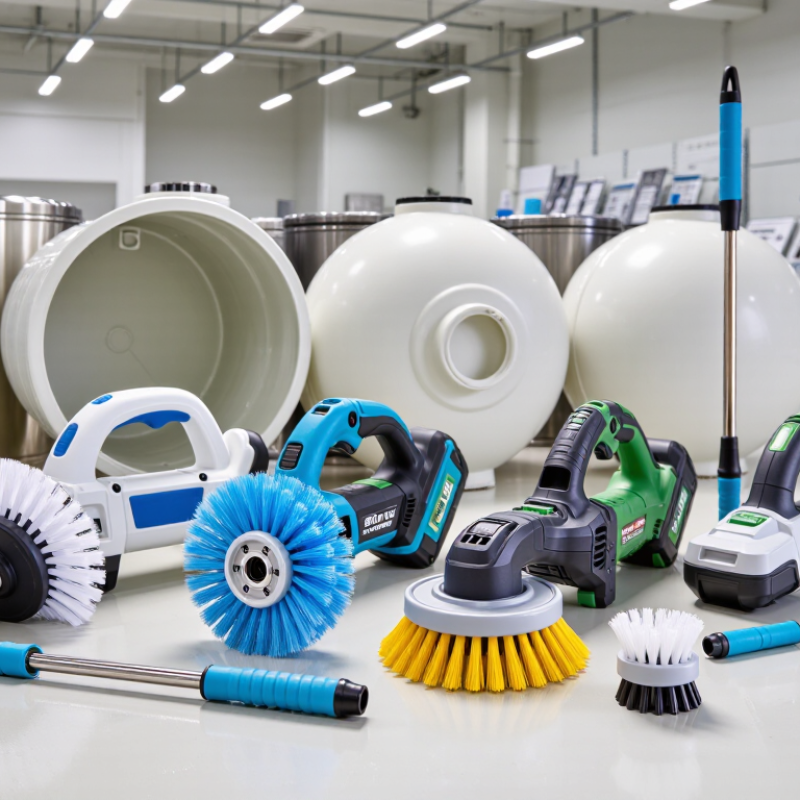
Electric tank-cleaning brushes typically use a rotating head on a rigid extension shaft or a flexible drive shaft for curved surfaces. Head size should match the tank’s access opening and internal geometry. Soft nylon bristles suit coated steel, fiberglass, and plastic; tougher bristles may help with stubborn deposits but can damage liners. A stronger brush is not always better. Not every tank needs the same tool.
Match the brush to tank material, residue, and cleaning access. Check shaft reach, speed control, waterproofing, and whether parts can be cleaned between uses. For potable-water tanks, use materials suitable for drinking-water contact, and follow the tank operator’s cleaning and disinfection procedure; brushing alone does not disinfect. The US EPA’s 2023 7th Drinking Water Infrastructure Needs Survey estimated $625 billion in drinking-water infrastructure needs over 20 years, including storage. It is a broad infrastructure estimate, not a tank-cleaning figure, but it highlights why routine maintenance matters.
Tips: Inspect a small area first. Use slow, steady passes around seams and outlets, where residue can collect. Rinse away loosened debris and check the surface afterward. A brush may miss corners; that is worth remembering.
Compare Motor Power, Brush Speed, and Runtime for Different Tank Sizes
For a small tank, choose a brush that can reach corners without excessive torque. In a medium tank, compare motor output under load, not just the wattage printed on a quotation. Large tanks need longer reach and steady operation; higher power alone does not guarantee faster cleaning. The U.S. Department of Energy’s 2014 U.S. Industrial Electric Motor Systems Market Opportunities Assessment reports that motor-driven systems use about 68% of electricity in U.S. manufacturing. Efficiency matters.
Brush speed should match the surface. A slow setting can help avoid splashing and reduce strain on delicate coatings; a faster setting may suit stubborn deposits. Ask suppliers for measured brush speed under load, plus a test video on a comparable surface. No-load speed is less useful. Tank geometry changes the result.
Runtime depends on battery capacity and actual draw. A practical estimate is usable battery watt-hours divided by motor watts; for planning, allow for losses and pauses. For example, a 500 Wh battery powering a 250 W motor gives about two hours before losses, not a promise. Check continuous-duty ratings against IEC 60034-1, and request runtime tests with the intended brush head. One weak point: tank volume alone is a poor sizing guide; access, residue, and water depth can matter more.
Best Water Tank Electric Brush Supplier in China? Compare Motor Power, Brush Speed, and Runtime
Illustrative selection benchmarks by tank capacity. Larger tanks may call for higher motor power, while brush speed and runtime should also suit the cleaning task and duty cycle.
Values are practical planning examples, not specifications from a particular supplier. Confirm actual motor ratings, brush RPM, and battery runtime with the manufacturer under your intended working conditions.
Check Wet-Use Protection: IEC 60529 IPX7 Covers Immersion at 1 m for 30 Minutes
Best Water Tank Electric Brush Supplier in China?
When comparing water tank electric brush suppliers in China, check what an IPX7 claim actually covers. Under IEC 60529, IPX7 testing involves temporary immersion in water up to 1 meter deep for 30 minutes, under specified conditions. It is a useful indicator of wet-use protection, but not proof that a brush can operate underwater. Nor does it automatically cover hot water, detergent, spray pressure, or damage from worn seals.
Ask suppliers for the test report and confirm which parts were tested: the complete brush, battery housing, switch, or another component. Check whether the reported model matches the product you plan to buy. A rating can be reassuring, yet details matter. A loose charging-port cover or cracked housing may reduce protection over time. Ask how seals are inspected during production and what care the instructions require.
Tips: Request written guidance on rinsing, drying, and charging after use. Never charge a wet brush unless its instructions explicitly permit it. If your team uses cleaning chemicals, verify compatibility separately; IPX7 alone does not establish chemical resistance. A small gap remains: real-world wear is difficult to capture in one test.
Evaluate Chinese Suppliers’ Quality Systems, Product Tests, and Traceability
Best Water Tank Electric Brush Supplier in China?
Choosing a water tank electric brush supplier in China takes more than reviewing a polished catalog. Ask how quality controls work on the production floor. A reliable supplier should provide inspection records for motors, cables, seals, and brush heads. Request recent test reports, not just a pass certificate. Ask whether each model is tested for runtime, heat buildup, water resistance, and bristle retention after repeated use. Test conditions matter. A number without a method offers little reassurance.
Tips: Request a sample linked to its production batch. Compare its label, inspection sheet, and test record. Check whether the supplier can trace the motor lot, assembly date, and final inspector. Keep one unit for a trial using the tank surfaces and cleaning routine you expect. Does the brush head stay secure after repeated scrubbing? Small details count.
A quality system is more than a certificate on the wall. Review calibration dates for test instruments, nonconformance records, and examples of corrective actions. Ask what changed after a failed test and how affected batches were handled. Some factories may initially provide incomplete records; ask follow-up questions before deciding. Neat paperwork can still leave ordinary questions unanswered. That deserves a closer look.