





Blog

China Best Produce Clamshells Supplier for Global Buyers

Choosing the right China supplier for Produce Clamshells requires more than comparing prices. Buyers need protection, presentation, consistency, and dependable communication. A clear specification should cover fruit size, hinge strength, ventilation, stacking, label placement, and closure performance. Small details matter. A weak hinge can open during transport. Excess moisture can damage berries before they reach store shelves.

Susan Selke, a respected packaging researcher and educator, has said, “Packaging is a system, not a single object.” This principle fits Produce Clamshells perfectly. The container must work with the produce, filling process, cold chain, warehouse equipment, retail display, and end-of-life expectations. Experienced Chinese manufacturers can support PET, rPET, and other suitable materials, while offering mold development, color control, sample testing, and scalable production. However, recycled content, food-contact suitability, and labeling requirements should always be verified for the destination market.

Reliable sourcing also depends on evidence. Request material declarations, dimensional drawings, production samples, inspection records, and practical drop or compression tests. Visit the factory when possible, or use an independent inspection partner. Do not trust attractive photos alone. They can hide uneven walls, sharp edges, or unstable lids. I have seen buyers focus heavily on unit cost and overlook freight space, rejected batches, and seasonal supply pressure. That approach needs reflection. The lowest quotation may become the most expensive decision. This guide introduces how global buyers can evaluate Chinese Produce Clamshells suppliers through product expertise, quality controls, customization capacity, communication discipline, and long-term reliability.
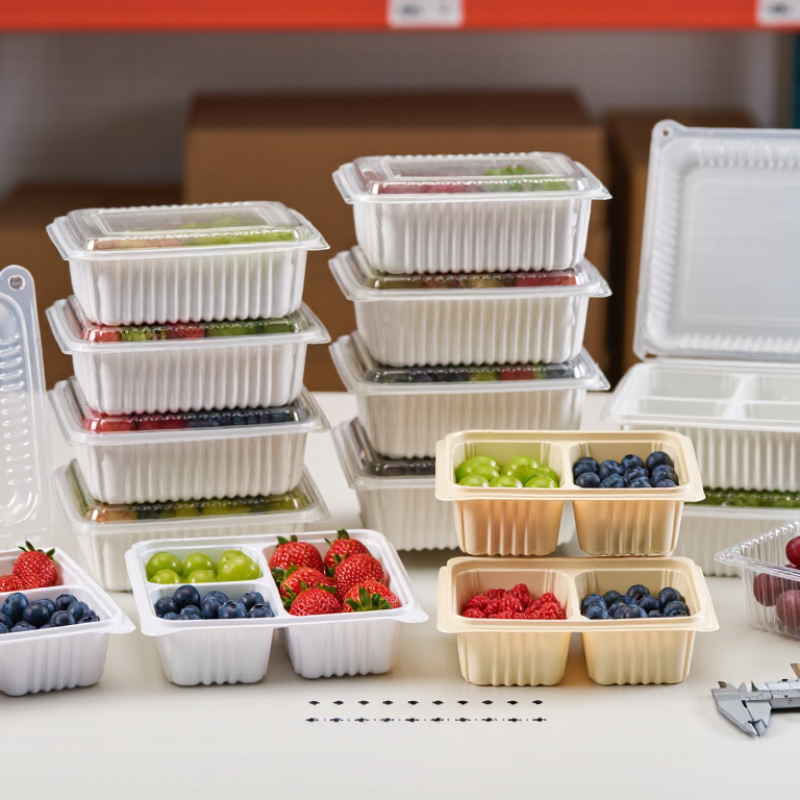
China Best Produce Clamshells Supplier for Global Buyers

Types and Features of Clamshell Packaging for Fresh Produce

Clamshell packaging protects fresh produce while keeping its quality visible. Common types include hinged clamshells, two-piece containers, vented packs, and stackable punnets. Hinged designs suit berries and cherry tomatoes because they open quickly and reduce loose components. Vented holes help release moisture from grapes, mushrooms, and leafy produce. Too many vents can cause dehydration, though.

PET clamshells offer strong clarity, impact resistance, and reliable sealing. Recycled PET can reduce virgin plastic use, but buyers should check recycled content and food-contact documents. Compostable materials may fit selected supply chains, yet their performance can change under humidity and cold storage. Not every clear pack is a better pack. Material choice must match the produce, transport route, and retail display period.

Experienced Chinese manufacturers usually support custom molds, sample testing, color control, and shipment inspections. Buyers should review wall thickness, hinge strength, closure force, drainage design, and stacking stability. A small trial can reveal cracking after cold transport or weak lids during pallet handling. Ask for production samples and test reports before large orders. Low prices sometimes hide uneven dimensions, poor ventilation, or inconsistent sealing. That lesson deserves attention. Reliable cooperation also depends on traceable materials, clear specifications, and responsive quality records.

Typical Fresh-Produce Clamshell Fill Weights

Common retail clamshell formats used for fresh produce, shown by typical net fill weight. Clear visibility, hinged closure, ventilation, and stackable geometry are widely used to protect products and support global distribution.

Fill weights are representative retail ranges and may vary by market, produce size, pack style, and buyer specifications.

Key Standards for Selecting a Reliable China Clamshell Supplier

China Best Produce Clamshells Supplier for Global Buyers

Selecting a reliable China clamshell supplier requires more than comparing unit prices. Ask for factory audit records, food-contact declarations, and batch-level inspection reports. ISO 9001 supports process control, while BRCGS Packaging Materials certification can strengthen supplier verification. These documents matter when containers hold berries, tomatoes, or cut produce directly.

Material performance needs practical proof. Request samples in the exact PET or rPET grade, size, and hinge design. Test stacking strength, closure fit, ventilation, and cold-storage performance. FAO estimates that 13.2% of food is lost between harvest and retail, so weak packaging can create measurable waste. A trustworthy supplier should explain resin sourcing, recycled content, and migration testing without hiding behind vague claims.

Traceability is essential. Each shipment should link to a production date, mold number, material batch, and inspection result. Check whether the supplier controls tooling, packing, and corrective actions internally. Factory visits help, but they are not perfect. Photos can mislead. A cheaper quote may exclude testing, export cartons, or replacement parts. Define tolerances in writing, then approve a pilot order before scaling. Small details reveal reliability.

Manufacturing Process and Quality Control of Produce Clamshells

China’s reliable produce clamshell production begins with controlled material selection. Food-grade PET or rPET pellets are checked for moisture, color, contamination, and melt consistency. Resin traceability matters.

Thermoforming temperature shapes the sheet around a precision mold. Operators monitor heating zones, forming pressure, cooling time, and wall thickness. A clear lid should close evenly, without sharp edges or cloudy stress marks. Vent holes must protect berries from condensation while limiting unnecessary dehydration. Small defects matter. In our production experience, hinge alignment often needs more attention than appearance. A beautiful pack can still fail during transport.

Quality teams test sealing force, lid opening cycles, drop resistance, stacking strength, and dimensional accuracy. Sampling plans can follow ISO 2859-1, while distribution tests may reference ASTM D4169. Food-contact materials also require documentation for the destination market. These checks are practical, not decorative. The UNEP Food Waste Index Report 2024 estimated 1.05 billion tonnes of food waste in 2022, making package protection a measurable supply-chain concern. FAO’s State of Food and Agriculture reported that 13.2% of food was lost globally between harvest and retail in 2021. Clamshells cannot solve every loss point. They can reduce bruising, contamination exposure, and handling damage when designed correctly. More testing is still needed for unusual produce sizes and recycled-content variations.

China Best Produce Clamshells Supplier for Global Buyers - Manufacturing Process and Quality Control of Produce Clamshells

Manufacturing / Quality Dimension Typical Specification or Control Point Common Industry Reference or Test Method Quality-Control Record
Primary Material Food-contact PET or recycled PET (rPET), selected according to the required clarity, stiffness, impact resistance, and regulatory market. Applicable food-contact requirements such as FDA 21 CFR 177.1630 or EU Regulation (EU) No. 10/2011, where relevant. Incoming-material certificate, supplier declaration of compliance, resin identification, and lot traceability.
Material Thickness Common produce clamshell thickness: approximately 0.30–0.80 mm, depending on package size, product weight, stacking requirement, and hinge design. Thickness measurement at defined points using a calibrated thickness gauge or micrometer. First-piece approval and periodic in-process thickness checks with recorded measurement locations.
Material Drying PET resin is dried before thermoforming to reduce moisture-related hydrolysis, brittleness, haze, and loss of mechanical performance. Drying temperature, residence time, and moisture level are controlled according to the resin supplier’s technical data sheet. Dryer temperature, dew point, drying time, and batch number.
Sheet Extrusion The dried resin is melted, filtered, extruded into sheet, cooled, and wound or fed for forming. Sheet gauge and surface clarity are controlled across the web. Visual inspection, thickness mapping, width measurement, and contamination screening. Extrusion line, production date, operator, sheet thickness profile, and nonconformance report if required.
Thermoforming Heated sheet is formed over a mold using vacuum and, where required, pressure or plug assistance to create the base, lid, ribs, vents, and locking features. Controlled heating profile, forming temperature, vacuum level, cycle time, and mold condition. Machine settings, mold identification, start-up approval, and hourly visual checks.
Cutting and Trimming The formed web is trimmed to the specified outline. Edges should be smooth, free from sharp burrs, tears, excessive flash, and loose particles. Visual edge inspection and dimensional measurement against the approved drawing. Trim-tool inspection, sample measurements, and line clearance record.
Overall Dimensions Length, width, height, flange size, hinge position, and nesting features are manufactured to the approved customer drawing. A practical general tolerance is often around ±1–2 mm, subject to design and size. Calipers, height gauges, coordinate measurement, or dedicated inspection fixtures. Dimensional inspection report with measured values and drawing revision.
Hinge Performance The living hinge should open and close smoothly without cracking, splitting, or separating from the lid and base. Required cycle performance depends on the design. Manual opening-and-closing test or defined repeated-cycle test on approved samples. Hinge inspection result, sample quantity, cycle count, and acceptance decision.
Lid-to-Base Lock The closure should engage consistently, resist accidental opening during handling, and remain accessible to the end user without damaging the package. Closure engagement check and, when specified, opening-force or retention-force testing. Functional test record, test sample identification, and defect classification.
Ventilation Design Vents may be incorporated to help manage condensation and airflow for berries, grapes, tomatoes, mushrooms, and other fresh produce. Vent area and location are product-specific. Approved drawing review, vent-count inspection, and visual verification of unobstructed openings. Vent dimensions, quantity, location, and tooling inspection record.
Clarity and Appearance Clear or specified-color surfaces should be free from black specks, gels, bubbles, severe haze, flow marks, burn marks, warpage, oil stains, and visible contamination. Standardized visual inspection under suitable lighting and viewing distance. Appearance checklist, defect photos where applicable, and inspection sampling level.
Food-Contact Hygiene Finished packages should be protected from dust, lubricants, metal fragments, moisture, and other contamination during production, inspection, and packing. Documented hygiene program, personnel practices, cleaning schedule, and applicable food-packaging requirements. Sanitation checklist, cleaning record, pest-control record, and production-area inspection.
Leak and Integrity Check Clamshells are checked for cracks, pinholes, split hinges, incomplete forming, and closure defects. Leak resistance is evaluated when the package design requires it. Visual inspection, water-fill check, dye check, or pressure/vacuum test according to the approved specification. Integrity-test method, sample quantity, results, and corrective-action record.
Stacking and Nesting Empty clamshells should nest without excessive sticking, deformation, or difficult separation. Stack height and nesting depth are checked for transport efficiency. Nesting test using production samples and approved carton configuration. Nesting quantity, stack height, separation result, and carton-pack test.
Compression and Handling Package strength is designed for the product weight, stacking pattern, cold-chain handling, and distribution environment. Acceptance values are established by the buyer’s packaging specification. Compression, drop, vibration, or transport simulation testing when required by the application. Test conditions, load, duration, sample configuration, and post-test inspection.
Quality Sampling Sampling frequency and acceptance criteria are defined by the purchase specification. Critical defects may require zero acceptance, while major and minor defect limits are agreed in advance. ISO 2859-1 or another buyer-approved statistical sampling plan. Sampling plan, inspection level, acceptance number, rejection number, and final inspection report.
Packaging and Storage Finished clamshells are nested, bagged or sleeved as specified, packed in clean cartons, and protected from heat, direct sunlight, dust, crushing, and deformation during storage and shipment. Approved packing instruction, carton-drop evaluation, and warehouse storage requirements. Carton quantity, pallet pattern, gross weight, lot code, packing date, and shipment inspection.
Traceability and Release Each production lot should be traceable from raw material through forming, inspection, packing, and shipment release. Documented quality-management and lot-control procedure. Lot number, production date, machine or mold reference, inspection records, and release authorization.

Note: The listed ranges are typical industry planning values rather than universal limits. Final specifications should be confirmed through the approved drawing, material declaration, product-use conditions, and destination-market regulations.

Customization, Sustainability, and Export Packaging Options

A reliable clamshell supplier should begin with the product, not a fixed mold. Fresh berries need airflow, while cut vegetables need stronger bases and leak control. We develop samples around weight, moisture, stacking, and shelf presentation. Small details matter. A 125-gram berry pack may need different vents from a 500-gram pack. Custom sizes, hinged lids, locking points, labels, and colors can be adjusted for different markets.

Sustainability requires practical decisions. Recycled PET can reduce virgin plastic use, but clarity and stiffness must remain acceptable. Mono-material designs may simplify recycling, although they are not always ideal for every product. We test material performance instead of making broad claims. Earlier samples sometimes looked excellent but cracked during cold storage. That failure changed our testing process. Export packaging also needs attention. Corrugated cartons should protect clamshells through humid warehouses, truck vibration, and container stacking. We can provide carton layouts, pallet plans, ventilation considerations, and export documentation support. Packaging marks and material information must match the destination market. Requirements differ. A dependable supplier checks these details before production, not after the shipment leaves.

How Global Buyers Can Evaluate Costs, Orders, and Supplier Support

When choosing a China-based clamshell supplier, global buyers should evaluate the complete cost, not only the unit price. Ask for separate quotes covering tooling, samples, packaging, inland delivery, and ocean freight. A low quotation may hide high minimum order quantities or weak carton protection. Request a sample packed like a real shipment. Check hinge strength, lid alignment, ventilation holes, and stacking performance.

Orders should match your seasonal produce plan. Confirm minimum quantities, production lead times, shipment windows, and tolerance for size or color variation. Share practical details, such as berry weight, pallet height, and expected weekly demand. Forecasts are rarely perfect. Leave some flexibility for weather and harvest changes. Written specifications reduce confusion, although they cannot prevent every production mistake.

Tips: Compare at least three detailed quotations. Ask for recent quality records, food-contact compliance documents, inspection procedures, and clear complaint handling. A reliable supplier should provide drawings, sample revisions, and timely production updates. Test communication before placing a large order. Notice whether answers are specific or vague. Also discuss replacement terms for damaged cartons or defective clamshells. Supplier support often matters more than a small price difference.