








Blog
China Top 10 Stainless Non Stick Cookware Manufacturers
China’s cookware industry includes manufacturers with different strengths, production scales, and quality-control practices. This guide to China’s top 10 stainless non-stick cookware manufacturers is designed to help buyers compare potential suppliers with care. Stainless Non Stick Cookware combines a stainless-steel body with a non-stick cooking surface, but performance depends on more than appearance. The base construction, coating consistency, handle attachment, and finish all deserve attention.
Details matter. A polished sample may look impressive under bright showroom lights, while everyday use reveals uneven heating or a coating that wears sooner than expected. For that reason, the manufacturers in this overview should be assessed through practical criteria, including product range, manufacturing experience, inspection procedures, customization options, and communication reliability. Buyers should also request current specifications, sample products, and clear information about testing. A factory’s claims are useful, but they are not independent proof.
No ranking can fit every buyer. A restaurant supplier may prioritize durability and repeat production, while a retailer may focus on design, packaging, and minimum order quantities. Some companies may publish limited technical information, making direct verification necessary. That is a real limitation, not a small detail. This introduction offers a starting point for research, rather than a guarantee of supplier performance. Compare each manufacturer against your own requirements, ask specific questions, and confirm important details before placing an order.
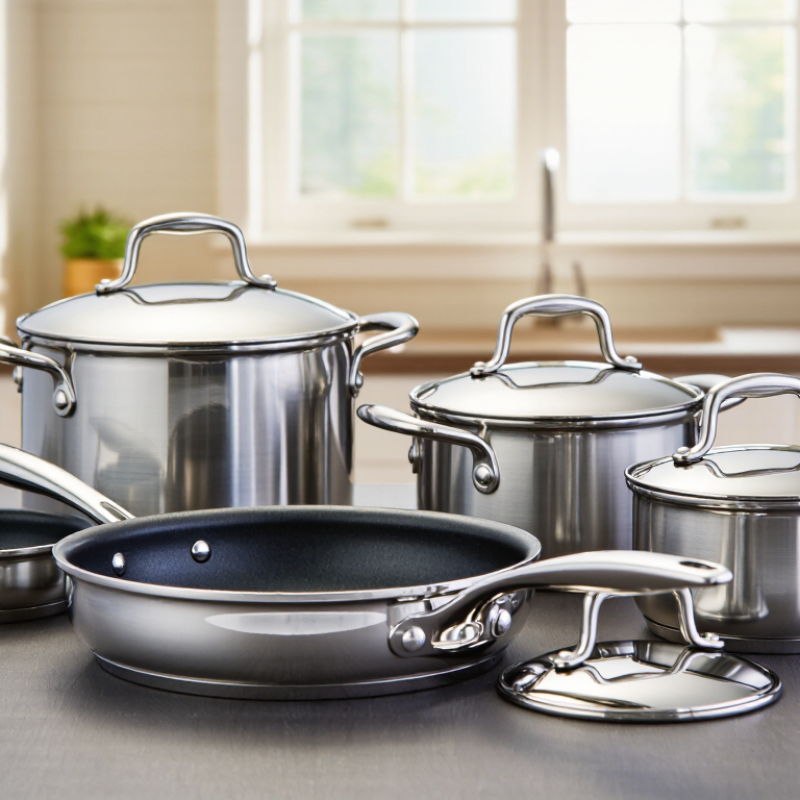
Understanding Stainless Steel Non-Stick Cookware and Its Key Features
Stainless steel non-stick cookware combines a steel body with a surface designed to release food more easily. The steel provides a sturdy cooking base and can distribute heat well, depending on the pan’s construction. The non-stick performance usually comes from a coating or specially engineered surface; bare stainless steel is not naturally non-stick. That distinction matters when comparing cookware specifications.
In everyday cooking, a properly heated pan and a small amount of oil can help reduce sticking. Avoid overheating an empty pan, since excessive heat may damage some non-stick coatings. Use utensils suited to the surface, and follow the maker’s care instructions. Even with careful use, release performance may change over time. That is normal, but worth considering before choosing a pan for frequent use. Stainless steel can also feel heavier than expected.
Tips: Warm the pan gradually, then add oil and food. If eggs cling, the surface may be too cool, too hot, or worn. Let the cookware cool before washing; sudden temperature changes can stress some constructions. A soft sponge is often gentler than abrasive scrubbing.
China Top 10 Stainless Non Stick Cookware Manufacturers - Understanding Stainless Steel Non-Stick Cookware and Its Key Features
| No. | Evaluation Dimension | Key Fact | What to Check in a Product or Supplier |
|---|---|---|---|
| 1 | Cooking-surface steel | Type 304 stainless steel is commonly described as 18/8 stainless steel, referring approximately to its chromium and nickel content. | Request the stated steel grade and supporting material documentation; do not rely on appearance alone. |
| 2 | Outer stainless layer | Type 430 stainless steel is magnetic and is often used in cookware bases or outer layers. | For induction use, check that the cookware has a suitable magnetic base; a magnet test is a simple preliminary check. |
| 3 | Clad construction | Multi-ply cookware combines layers of different metals. Aluminum or copper layers can help spread heat, while stainless steel provides a durable cooking surface. | Ask which layers extend up the sidewalls and which are limited to the base; construction varies by product. |
| 4 | Non-stick coating type | Common non-stick systems include PTFE-based coatings and sol-gel coatings often marketed as ceramic non-stick. | Confirm the coating type, care instructions, and applicable food-contact compliance documents for the intended market. |
| 5 | Coating-layer durability | Coating life depends on formulation, application, cookware use, and care; there is no single service-life figure that applies to every pan. | Review the supplier’s abrasion or cooking-cycle test method, results, and warranty terms rather than comparing unsupported cycle claims. |
| 6 | Heat-use guidance | Non-stick cookware is generally best used at low-to-medium heat. The maximum safe temperature depends on the coating and the complete product design. | Use the manufacturer’s stated temperature limit. Avoid heating an empty coated pan unless its instructions specifically allow it. |
| 7 | Induction compatibility | Induction cooktops require a magnetic cookware base that can couple with the cooktop’s magnetic field. | Check the product’s induction statement and test the base; a stainless-steel appearance by itself does not guarantee compatibility. |
| 8 | Handle and attachment | Handle material, attachment method, and design affect handling and oven suitability. Riveted and welded attachments are both used in cookware. | Check handle stability, grip, cleaning access, and the oven-temperature limit of the handle and any other components. |
| 9 | Cleaning and care | Dishwasher suitability varies by coating, handle, and product construction; hand washing can help preserve many non-stick surfaces. | Follow the product’s care instructions. Use non-abrasive utensils and cleaners when recommended by the manufacturer. |
| 10 | Claims and verification | Terms such as “PFOA-free” describe a specific claim and do not, by themselves, establish that a product is free of all PFAS or other substances. | Request precise claim definitions, test scope, and current third-party or regulatory documentation relevant to the destination market. |
Note: Specifications and performance vary by product. Verify material, coating, temperature, and care details against the product’s documentation.