





Blog

What Are the China Top 10 MPO Cable Manufacturers?

China’s MPO Cable industry has become a major source for high-density data center connectivity. This article examines ten leading Chinese manufacturers with practical, evidence-based criteria. The list considers product consistency, factory capacity, connector polishing, testing methods, and international support.

Jim Hayes, a veteran fiber-optics educator and president of the Fiber Optics Association, offers a useful warning: “Specifications do not replace workmanship.” That principle matters when comparing MPO Cable suppliers. A polished connector may look perfect under normal lighting. Microscopic contamination can still increase insertion loss. Poor polarity control can disrupt an entire high-density link.

This review will examine manufacturers serving data centers, telecom networks, enterprise systems, and emerging 400G or 800G environments. It will consider twelve-fiber and twenty-four-fiber designs, single-mode and multimode options, low-loss performance, bend-insensitive fiber, and custom fanout assemblies. Certifications and test reports will receive attention, but they will not decide everything.

Real reliability is broader.

A strong supplier should provide traceable inspection records, stable delivery schedules, clear drawings, and responsive engineering support. Pricing also matters, though the cheapest quotation may hide weaker inspection or inconsistent materials. Some companies have impressive websites but limited publicly verifiable production evidence. That uncertainty deserves careful treatment.

Therefore, this ranking is not an absolute verdict. It is a practical starting point for engineers, distributors, and purchasing teams. Readers should verify current certifications, samples, factory capabilities, and after-sales commitments before selecting a manufacturer. The market changes quickly, and even a respected supplier can show uneven performance across different production batches.
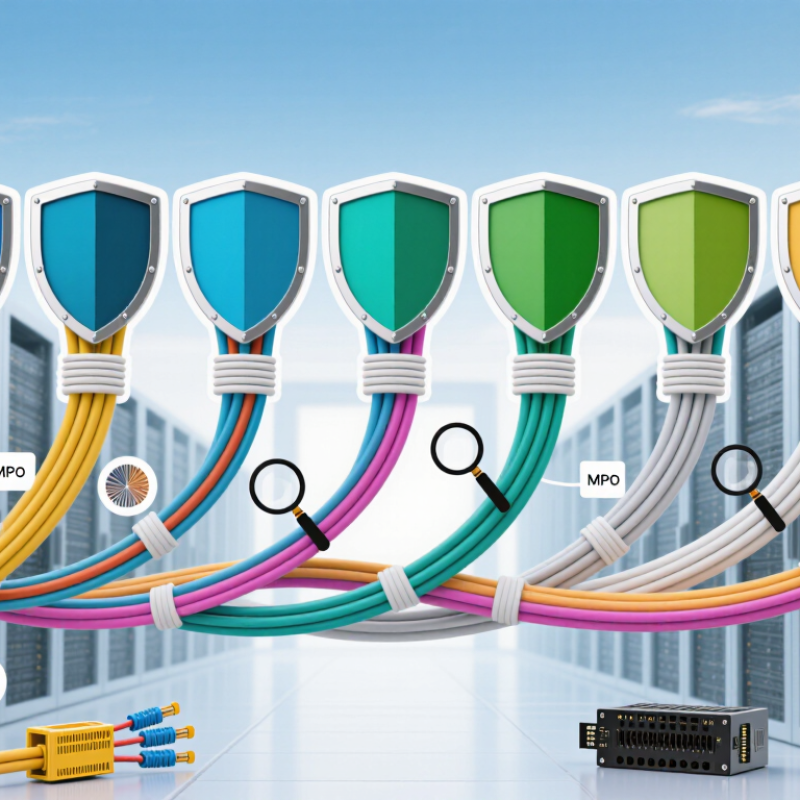
What Are the China Top 10 MPO Cable Manufacturers?

What Is an MPO Cable and Why Does Manufacturer Selection Matter?

An MPO cable is a factory-terminated fiber assembly with multiple fibers in one connector. It supports high-density links in data centers and telecom rooms. A single connector may carry 8, 12, 16, or 24 fibers. This design reduces cable congestion, but it leaves less room for mistakes. Polarity, fiber count, connector gender, and key orientation must match the equipment.

Manufacturer selection matters because performance depends on more than polished end faces. A reliable manufacturer should provide insertion-loss data, return-loss results, polarity records, and end-face inspection evidence. It should also identify the fiber type, such as OM4 or OS2, and state the test method clearly. In real installations, technicians often discover problems at the cassette or adapter, not inside the cable. Clear labeling and traceable inspection records save hours during troubleshooting.

Practical details deserve attention. Check the bend radius before routing the cable through a crowded cabinet. Confirm the pulling eye and protective boot before installation. Ask whether the supplier can control length tolerance and connector cleanliness. I have seen experienced teams overlook polarity because the cable looked correct. That mistake caused an entire link to remain dark. A manufacturer may offer an attractive price, yet inconsistent testing can create expensive rework. Selection should therefore consider engineering support, packaging quality, production consistency, and documented quality control. No process is perfect; even a strong supplier needs independent checks before deployment.

How Are China’s Top MPO Cable Manufacturers Evaluated?

Evaluating China’s top 10 MPO cable manufacturers requires more than comparing factory prices. The 2024 MarketsandMarkets Optical Transceiver Market report projects growth from about USD 11.8 billion in 2023 to USD 19.3 billion by 2028. This expansion increases demand for reliable, high-density fiber connections in data centers. MPO manufacturers should therefore demonstrate stable production, not only fast quotations.

Technical inspection begins with insertion loss, return loss, polarity, and connector geometry. For low-loss multimode assemblies, buyers often specify insertion loss near or below 0.35 dB and return loss of at least 20 dB. These figures must come from individual test records, not a sample certificate. IEC 61754-7 defines MPO interface requirements, while IEC 61300-3-35 supports end-face inspection. Cleanliness matters. One dust particle can disturb several channels.

Auditors should also examine 3D interferometer results, fiber-length tolerance, tensile performance, bend behavior, and packaging protection. A credible factory links every cable to a test date, operator, instrument, and calibration record. Field audits often find impressive samples but inconsistent second batches. That gap deserves attention. Delivery data should include defect rates, replacement handling, and documented corrective actions. The evaluation can remain imperfect, because public rankings rarely reveal yield, rework, or long-term failure rates. Price alone is weak evidence.

What Are the China Top 10 MPO Cable Manufacturers?

China’s top 10 MPO cable manufacturers are often judged by more than production scale. Reliable suppliers show stable fiber performance, accurate polarity control, and consistent connector quality. They usually provide factory testing records, insertion-loss data, and clear product traceability. Experienced buyers also inspect cable geometry, pull strength, and bend performance before placing large orders. A polished website is not enough.

The strongest manufacturers support common data-center applications, including 8-fiber, 12-fiber, and 24-fiber MPO assemblies. They can customize fiber types, jacket materials, breakout lengths, and connector configurations. Production experience matters when thousands of links must fit the same rack layout. However, “top ten” rankings can be subjective. Some lists reflect exports, while others focus on engineering capability or delivery speed. Buyers should verify current certifications, sample quality, and after-sales response instead of trusting a fixed ranking.

Tips: Request samples from several manufacturers and compare test reports directly. Check whether the stated loss matches actual measurements. Ask for polarity diagrams before approving the order. Confirm packaging details, especially for long-distance shipping. One overlooked issue is labeling; unclear labels can slow installation and create avoidable testing work. A supplier may appear technically strong, yet weak documentation can still cause project delays. Independent inspection is sensible for critical network deployments.

How Do These Manufacturers Compare in Products and Capabilities?

China’s top ten MPO cable manufacturers differ most in engineering depth, not catalog size. Some focus on standard 8-, 12-, or 24-fiber trunks for data centers. Others build customized 16-, 32-, or 48-fiber assemblies for high-density networks. Product quality depends on connector polishing, fiber alignment, polarity control, and stable insertion loss. Small details matter.

In installation projects, experienced suppliers usually offer trunk cables, breakout assemblies, adapter panels, cleaning tools, and test reports. Their better products include low-smoke, halogen-free jackets, bend-sensitive fiber, pull eyes, and clear polarity labels. These features reduce confusion inside crowded cabinets. A capable manufacturer can also support single-mode and multimode designs, different connector angles, and precise cable lengths. Fast production is useful, but repeatable testing matters more.

Manufacturing capability separates reliable suppliers from simple assemblers. Strong factories use automated polishing equipment, microscope inspection, interferometer testing, and 3D end-face analysis. They should provide insertion-loss records for each batch, not only general claims. Custom engineering is another useful measure. Can the supplier adjust fanout length after a rack survey? Can it manage thousands of identical assemblies without mixing polarity? These questions expose weaknesses. The “top ten” label can also mislead, because rankings often depend on export volume rather than field performance. In practice, a lower-priced cable may appear attractive, yet inconsistent geometry can create difficult troubleshooting later. I would still verify samples, test methods, packaging, and production traceability before approving a large order.

What Are the China Top 10 MPO Cable Manufacturers? - How Do These Manufacturers Compare in Products and Capabilities?

An anonymized comparison of ten representative China-based MPO cable manufacturing profiles. The comparison focuses on publicly standardized product specifications, manufacturing scope, quality systems, and typical deployment capabilities rather than displaying company or brand names.

Profile Manufacturer Type Primary MPO Product Range Supported Fiber Counts Fiber and Cable Types Typical Insertion Loss Typical Return Loss Polarity and Gender Options Customization Capability Quality and Compliance Scope Typical Applications
01 Integrated supplier MPO trunk cables, harnesses, breakout assemblies, adapter panels, and cassettes 8, 12, 16, 24, 32, and 48 fibers OS2 single-mode; OM3, OM4, and OM5 multimode; round and ribbon cable Standard: ≤0.35 dB; low-loss: ≤0.25 dB Single-mode: typically ≥55 dB; multimode: typically ≥35 dB Polarity Methods A, B, and C; male and female connector configurations High; custom lengths, fan-out ratios, labels, pull eyes, and jacket materials ISO 9001-oriented quality systems; RoHS and REACH material compliance commonly available Data centers, server rooms, backbone links, and high-density patching
02 High-density specialist MPO/MTP-compatible trunks, ultra-high-density modules, and rack-mounted distribution units 8, 12, 16, 24, and 32 fibers OS2, OM3, and OM4; compact round cable and reduced-diameter trunk designs Standard: ≤0.35 dB; low-loss options generally ≤0.30 dB Single-mode: typically ≥55 dB; multimode: typically ≥30–35 dB Type A and Type B assemblies; pin and non-pin connector options High; rack unit height, connector orientation, module count, and cable diameter RoHS-compliant component options; IEC and TIA/ISO interface practices commonly supported High-density data-center cross-connects and leaf-spine networks
03 Custom assembly producer MPO patch cords, fan-out cables, conversion harnesses, and pre-terminated assemblies 8, 12, 24, and 48 fibers OS2 single-mode; OM3 and OM4 multimode; PVC, LSZH, and plenum-style jacket options Standard: ≤0.40 dB; selected low-loss assemblies: ≤0.30 dB Single-mode: ≥50–55 dB; multimode: ≥30 dB Methods A, B, and C available by order; male or female ends Very high; customized breakout legs, connector combinations, and identification schemes Factory end-face inspection, polarity testing, and interferometer testing available by specification Telecommunications rooms, enterprise networks, and equipment interconnects
04 Fiber-optic component maker MPO adapters, couplers, panels, splice modules, and basic trunk assemblies 8, 12, 16, and 24 fibers OS2, OM3, and OM4; single-mode and multimode connector families Passive components: typically ≤0.30–0.50 dB; cable assemblies: ≤0.40 dB Typically ≥35 dB for multimode and ≥50 dB for single-mode interfaces Key-up/key-down adapter orientations; male and female assemblies Medium to high; panel formats, adapter colors, labels, and port counts RoHS material options; dimensional and optical inspection normally included ODF systems, patch panels, structured cabling, and telecom distribution
05 Data-center cabling supplier Pre-terminated trunks, cassettes, patch panels, and modular cabling systems 8, 12, 16, 24, and 32 fibers OS2, OM3, OM4, and selected OM5 products; compact and standard-diameter cable Standard: ≤0.35 dB; enhanced low-loss products: ≤0.25–0.30 dB Single-mode: ≥55 dB; multimode: ≥35 dB Methods A and B are common; gender and keying specified for system compatibility High; cassette mapping, port numbering, cable lengths, and rack layouts Testing commonly covers continuity, polarity, insertion loss, and end-face condition 40G, 100G, 200G, and 400G structured data-center cabling
06 Telecom-oriented producer Outdoor-rated MPO trunks, indoor/outdoor assemblies, and fiber-distribution products 12, 24, 36, and 48 fibers OS2 single-mode; armored, rodent-resistant, LSZH, and UV-resistant cable options Typically ≤0.40 dB; low-loss options available for selected assemblies Typically ≥50 dB for single-mode assemblies Methods A and B; ruggedized connector and boot options available Medium to high; armor, pulling eye, breakout protection, and environmental sealing Environmental and mechanical tests may include tensile, bend, temperature, and water exposure Telecom backbones, central offices, outdoor cabinets, and mobile-network sites
07 OEM/ODM assembly factory Private-label-ready MPO cables, harnesses, modules, and customized packaging 8, 12, 16, 24, 32, and 48 fibers OS2, OM3, OM4, and OM5; PVC, LSZH, and plenum-style jacket options Standard: ≤0.40 dB; low-loss: commonly ≤0.30 dB Single-mode: ≥50–55 dB; multimode: ≥30–35 dB All common polarity methods subject to project specification; male/female options Very high; drawings, packaging, labeling, bill-of-material control, and mixed assemblies Batch traceability, optical test reports, and customer-specific inspection plans available Distributor programs, system integrators, international projects, and replacement programs
08 Ruggedized cable specialist Industrial MPO assemblies, armored trunks, ruggedized breakout cables, and protective boots 12, 24, and 48 fibers OS2 and OM4; armored, high-flex, flame-retardant, and industrial-jacket designs Typically ≤0.40 dB; selected products may achieve ≤0.30 dB Single-mode: typically ≥50 dB; multimode: typically ≥30 dB Methods A and B; ruggedized housings and keyed connector configurations High; mechanical protection, ingress protection, bend radius, and connector boot design Mechanical and environmental qualification is usually project-specific Industrial automation, transportation, military-related infrastructure, and harsh environments
09 Value-focused volume supplier Standard MPO patch cords, trunk cables, adapters, and entry-level modules 8, 12, 24, and 48 fibers OS2, OM3, and OM4; standard round cable and common jacket materials Typically ≤0.50 dB; standard low-loss options around ≤0.35 dB Typically ≥35 dB for multimode and ≥50 dB for single-mode products Methods A and B; common male and female configurations Medium; standard lengths, colors, labels, and connector combinations Basic continuity, polarity, and insertion-loss testing; documentation varies by order General structured cabling, enterprise upgrades, and routine maintenance
10 Specialty low-loss supplier Low-loss MPO trunks, high-performance harnesses, and transmission-grade modules 8, 12, 16, 24, and 32 fibers OS2, OM4, and OM5; bend-insensitive single-mode and optimized multimode options Low-loss assemblies commonly ≤0.25 dB; standard versions ≤0.35 dB Single-mode: typically ≥55 dB; multimode: typically ≥35 dB Methods A, B, and C; polarity and gender controlled through assembly drawings High; optical targets, polarity maps, end-face requirements, and test-report formats Detailed optical test records, end-face inspection, and batch traceability commonly offered High-speed data centers, telecom transport, laboratory networks, and demanding backbone links

Technical note: MPO performance depends on connector grade, fiber type, polishing process, test method, and applicable standard. Typical insertion-loss and return-loss figures shown above are industry specification ranges rather than guaranteed values for every production batch. Buyers should request current datasheets, polarity drawings, end-face inspection records, and lot-specific test reports before placing an order.

What Factors Should Buyers Consider Before Choosing a Manufacturer?

When comparing China’s top 10 MPO cable manufacturers, buyers should look beyond rankings and polished websites. A capable supplier must match the cable design to the actual network environment. Check fiber type, polarity, connector gender, insertion loss, return loss, and trunk length. Small errors can create serious installation delays.

Ask for recent test reports from calibrated equipment. Confirm whether every assembly receives individual inspection. Reliable factories should provide serial-number traceability, material records, and clear quality procedures. Their products should follow relevant industry standards, such as IEC and TIA requirements. Certification alone is not enough. The testing scope matters.

Request samples before placing a large order. Inspect connector housing, pull strength, cable jacket markings, and fanout protection. Test the sample after repeated bending and cleaning. Production capacity also deserves attention. A factory may produce excellent prototypes but struggle with consistent volume. That difference is easy to miss.

Communication shows practical experience. Can the engineering team explain polarity options without vague answers? Can it propose a workable solution for dense server racks? Ask about lead times, replacement handling, and technical support after delivery. One mistake is choosing the lowest quotation too quickly. I have seen a cheaper cable become expensive after rework, shipping delays, and port cleaning problems. Some supplier promises also sound stronger than their evidence. Request documents, not assurances.

What Are the China Top 10 MPO Cable Manufacturers? What Factors Should Buyers Consider?

This 100-point procurement scorecard highlights the factors buyers can use when comparing MPO cable manufacturers. Technical performance, standards compliance, customization, quality control, and supply reliability should be evaluated together rather than by price alone.

The weighting is a practical evaluation model, not a ranking of any specific company or brand. Buyers should verify test reports, IEC/ISO compliance, insertion-loss and return-loss results, fiber-count options, polarity support, inspection procedures, lead times, and warranty terms before placing an order.