


Blog

China Top Air Purifier Manufacturers for Global Buyers

The global air purifier market is becoming more demanding, not merely larger. IQAir’s 2024 World Air Quality Report found that only 17% of monitored cities met the World Health Organization’s annual PM2.5 guideline. The finding is uncomfortable. Indoor air deserves equal attention.

Chinese manufacturers now serve buyers across homes, schools, hospitals, offices, and hotels. Their advantages often include mature supply chains, flexible private-label production, and competitive engineering costs. Yet product quality can vary sharply between factories. A polished website proves little. Independent testing matters more.

This guide examines China’s leading air purifier manufacturers through measurable criteria. These include clean air delivery rate, filter efficiency, noise output, energy use, ozone emissions, factory audits, and after-sales support. Buyers should request test reports, not only marketing claims. They should also confirm whether testing follows relevant standards, such as AHAM, EN, or applicable IEC requirements.

Dr. Richard Corsi, a widely cited indoor-air-quality expert, has emphasized, “There is no silver bullet for indoor air quality.” That principle should shape every purchasing decision. An air purifier cannot replace source control, ventilation, or proper maintenance. It can, however, strengthen a layered indoor-air strategy.

The U.S. Environmental Protection Agency reports that indoor pollutant levels can sometimes exceed outdoor levels. Small rooms make weak performance visible: odors return, filters darken, and fan noise becomes difficult to ignore. These details matter to real users.

Some rankings remain imperfect. Public data is uneven, and factory claims require verification. Still, careful comparison can reduce procurement risk. This overview helps global buyers identify credible Chinese partners, ask sharper questions, and choose performance over attractive promises.
China Top Air Purifier Manufacturers for Global Buyers

China’s Air Purifier Industry: Market Scale, Standards, and Export Position

China’s air purifier industry has grown into a major manufacturing and export base. Its strength comes from mature electronics supply chains, filter production, and flexible OEM capacity. Production ranges from compact bedroom units to large commercial systems. However, factory scale alone does not prove product quality. Buyers should examine test reports, production records, and after-sales support.

China’s market is shaped by indoor air concerns, urban households, and demand for quieter appliances. Common performance checks include CADR, particle removal, noise, energy use, and ozone emissions. GB/T 18801 is widely referenced for household air cleaners in China. Export models may also require destination-specific EMC, safety, energy, and chemical compliance. Requirements can change, so current certificates deserve independent verification. China’s export position is strong, yet quality consistency remains uneven. That is an uncomfortable but important observation.

Tips: Request samples from regular production, not special batches. Compare laboratory data with real room performance. Check filter availability and replacement costs. Ask whether testing covers the exact model and voltage. A clear serial-number system helps trace defects. Do not rely on marketing terms such as “medical grade” without evidence. Small details matter. A purifier with excellent CADR may still disappoint if its sensor drifts, its fan becomes loud, or replacement filters are difficult to source.waswo

How CADR, CCM, and 99.97% HEPA Efficiency Define Product Performance

For global buyers, air purifier performance begins with three measurable indicators: CADR, CCM, and HEPA efficiency. CADR shows how quickly a unit delivers filtered air, usually measured for smoke, dust, or pollen. A higher CADR may clean a larger room faster. However, room layout, ceiling height, and open doors can reduce real-world results. A strong specification is not always a strong user experience.

CCM measures the filter’s capacity before particulate removal declines significantly. Higher CCM usually means longer service life and fewer replacements. The 99.97% HEPA figure describes particle capture under controlled test conditions, commonly around 0.3 microns. It does not guarantee identical performance in every household. Housing leaks, poor sealing, and weak airflow can matter. Buyers should request independent test reports, testing standards, noise data, and replacement-filter details from manufacturers.

Tips: Compare CADR with the intended room size, not only the headline number. Check whether HEPA efficiency applies to the filter or the complete machine. Ask for CCM results in clear units. A lower-noise model may be used more consistently, even with slightly lower maximum CADR. Specifications can look impressive. Verification remains essential.

China Top Air Purifier Manufacturers for Global Buyers - How CADR, CCM, and 99.97% HEPA Efficiency Define Product Performance

Performance Dimension Practical Benchmark What the Data Means How Global Buyers Should Evaluate It
Particle CADR 200–800 m³/h is a common residential range Clean Air Delivery Rate measures the volume of filtered air delivered per hour. A higher CADR generally indicates faster particle removal. Compare CADR values tested under the same standard and expressed in the same unit. Do not judge cleaning speed from HEPA efficiency alone.
Estimated Room Area at 5 Air Changes per Hour 200 m³/h: approximately 16 m²
350 m³/h: approximately 28 m²
500 m³/h: approximately 40 m²
800 m³/h: approximately 64 m²
Estimates use: room area = CADR ÷ (target air changes × ceiling height), assuming a 2.5 m ceiling and 5 air changes per hour. Use a larger CADR for open-plan rooms, high ceilings, pollution events, or faster purification. Actual results vary with room leakage, furniture, and operating speed.
HEPA Particle Filtration 99.97% removal at 0.3 µm for a true HEPA claim under the applicable test method The 0.3 µm particle size is commonly used as the most penetrating particle size reference for HEPA testing. Efficiency and CADR are separate performance metrics. Request the filter test report, filter classification, airflow data, and evidence of sealing around the filter. A high-efficiency filter cannot compensate for weak airflow or air bypass.
Filter Sealing and Air Leakage Continuous perimeter sealing with minimal bypass around the filter frame The overall appliance must control leakage around the filter, housing, and access panel; filter-media efficiency alone does not represent whole-unit performance. Check whole-appliance particle removal results, gasket design, assembly tolerances, and post-assembly inspection requirements.
Particulate CCM Higher CCM grades indicate greater cumulative particle-cleaning capacity before performance falls to the specified limit CCM, or Cumulate Clean Mass, evaluates how much particulate matter a filter can retain during a defined loading test. It is different from single-pass efficiency. For areas with smoke, dust, or seasonal haze, prioritize a higher particulate CCM and a larger filter-media area to reduce replacement frequency.
Gaseous CCM Higher gaseous CCM indicates greater cumulative removal capacity for specified gases Gaseous CCM evaluates the cumulative capacity of activated carbon or other sorbent media for selected pollutants. Results depend strongly on gas type, humidity, and test conditions. Ask which gases were tested, the sorbent mass, test concentration, humidity, airflow, and endpoint. Carbon weight alone is not proof of real-world performance.
Air Changes per Hour (ACH) 4–6 ACH is a useful residential planning target for particle control ACH is calculated as CADR × 60 ÷ room volume. It describes how quickly the purifier can deliver an equivalent volume of clean air. Select a model that can achieve the target ACH without relying continuously on its loudest operating mode.
Noise Output Approximately 20–35 dB(A) at low speed; approximately 45–65 dB(A) at high speed is common for residential units Noise depends on fan speed, distance, room acoustics, and measurement conditions. A declared test distance and operating mode are essential for comparison. Request noise data at every fan speed, especially the speed used to achieve the declared CADR. Quiet sleep mode may provide substantially lower airflow.
Energy Consumption Approximately 5–80 W for many residential models, depending on fan size and operating speed Power demand rises with airflow, motor load, sensor operation, ionization functions, and control electronics. Compare watts at the same CADR or ACH rather than comparing standby or sleep-mode power only. Check regional voltage and efficiency requirements.
Filter Service Life Often 6–12 months in typical residential use, but heavily polluted environments may shorten this period Service life depends on particulate loading, operating hours, fan speed, humidity, carbon quantity, and the manufacturer’s replacement criterion. Request a defined replacement rule, filter availability, packaging shelf life, replacement cost, and an accessible filter-change indicator.
Particle Sensor Performance Useful for automatic control, but not a substitute for certified CADR or filtration testing Low-cost optical sensors can respond differently to particle size, composition, humidity, and airflow. Displayed PM2.5 values may not equal reference-instrument readings. Evaluate sensor calibration, response time, automatic-mode logic, alarm thresholds, and whether the sensor can be cleaned or replaced.
Compliance and Documentation Applicable safety, EMC, energy, chemical, and market-specific requirements must be documented Requirements vary by destination market. Supporting documents may include laboratory reports, declarations, product labels, user manuals, and factory quality records. Confirm the exact model number, rated voltage, plug type, test standard, report validity, and whether the documentation covers the final production configuration.

Technical note: Room-area estimates are engineering calculations based on 5 ACH and a 2.5 m ceiling, not guaranteed coverage claims. CADR, CCM, HEPA efficiency, noise, and energy data should be compared only when the test conditions and standards are equivalent.

Leading Chinese Manufacturers by Technology, Certifications, and Production Capacity

China’s air purifier sector combines engineering depth with large-scale manufacturing. The World Health Organization reports that 99% of people breathe air above its recommended PM2.5 guideline. This keeps filtration performance commercially important.

Leading Chinese manufacturers typically develop brushless motors, particulate sensors, activated-carbon filters, and high-efficiency filter modules. Independent laboratories should verify CADR, noise, energy use, and ozone emissions. The AHAM standard remains useful for comparing room-cleaning performance. However, CADR figures can vary between test methods.

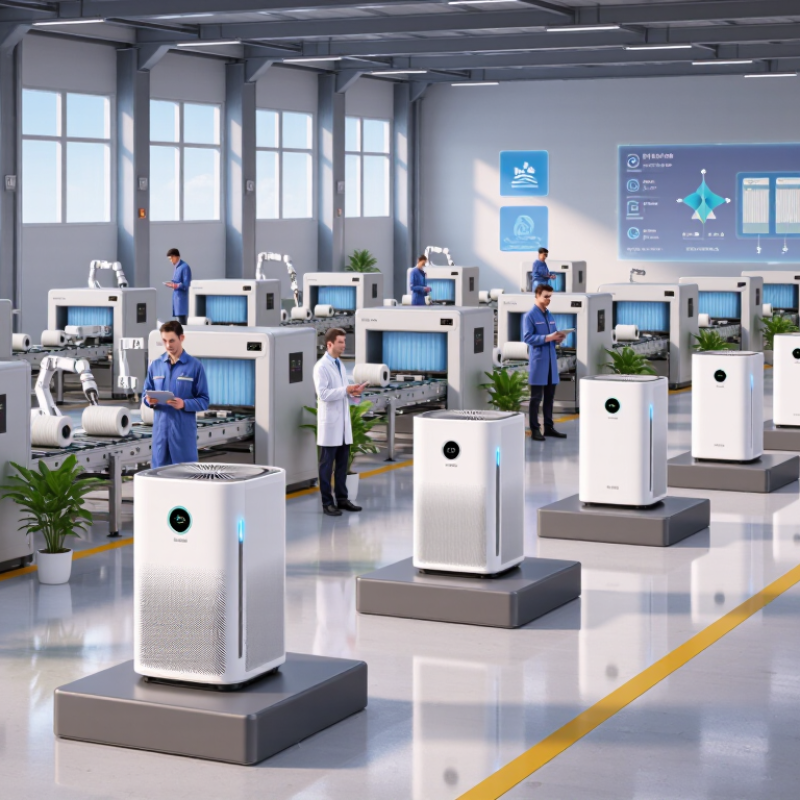
Certifications reveal more than a logo. Buyers should check ISO 9001 quality systems, ISO 14001 environmental controls, CE and RoHS documentation, and applicable CB safety reports. Test reports should show model numbers, laboratory details, and valid dates. Production capacity also needs physical evidence: automated assembly lines, filter-sealing stations, aging racks, and serial-number traceability. Industry reports from MarketsandMarkets forecast continued growth in the global air purifier market, driven by urban pollution and health awareness. Still, factory capacity claims are sometimes self-reported. That deserves scrutiny. A factory tour, sample inspection, and batch-level quality records provide stronger evidence than brochures. Product consistency matters most.

Global Buyer Evaluation: ISO, CE, RoHS, CB, and GB/T 18801-2022 Compliance

When evaluating China’s top air purifier manufacturers, global buyers should inspect compliance beyond product brochures. ISO certification can indicate controlled quality systems, but it does not prove purifier performance. Ask for the certificate scope, issuing body, and valid dates. Verify that the audited factory matches the actual production site.

CE compliance supports access to applicable European markets, while RoHS documentation helps confirm limits on restricted substances. The CB Scheme can simplify international electrical safety evaluations, but reports must match the exact model and voltage. GB/T 18801-2022 is especially important for Chinese-market performance testing, including clean air delivery and pollutant removal claims. Do not accept a test report for a similar model. That mistake is common.

Tips: Request complete reports, not certificate screenshots. Check model numbers, test conditions, laboratory accreditation, and report dates. Compare CADR values with room size and noise data. Filter replacement costs also matter. They are often overlooked.

Factory visits can add useful evidence. Observe incoming material checks, sealing tests, electrical safety testing, and final inspection records. Ask how production changes are controlled after certification. A reliable supplier should explain deviations clearly, even when the answer is not perfect. Certificates can expire. Standards can also change. Independent verification remains worthwhile before large orders, private labeling, or long-term supply agreements.

China Top Air Purifier Manufacturers for Global Buyers

Global Buyer Evaluation: ISO, CE, RoHS, CB, and GB/T 18801-2022 Compliance

This chart presents the official reference years associated with major quality, market-access, safety, environmental, and air-purifier requirements commonly reviewed by global buyers. ISO 9001:2015 is a quality-management standard, CE is an EU conformity marking framework, RoHS is based on Directive 2011/65/EU, the IEC CB Scheme was established in 1985, and GB/T 18801-2022 is China’s current national standard for household air cleaners. These milestones describe compliance frameworks rather than company-specific certification results.

References: ISO 9001:2015; EU Directive 2011/65/EU; IEC CB Scheme; GB/T 18801-2022; EU CE marking framework.

Procurement Criteria: MOQ, OEM Capability, Warranty, Testing, and After-Sales Support

China Top Air Purifier Manufacturers for Global Buyers

Procurement should begin with a realistic MOQ discussion, not a promotional catalog. Ask whether the quoted quantity applies per model, color, or filter specification. A factory may accept 300 units for a standard model but require 1,000 units for custom housing. Request a production sample before paying for tooling. Check noise levels, airflow, power consumption, and filter replacement access in a real room.

OEM Capability

OEM capability requires more than printing a logo. Confirm whether the manufacturer can modify firmware, control panels, packaging, and user manuals. Review drawings with measurable tolerances. Small details matter. A loose filter door can create noise and customer complaints. Warranty terms should identify coverage periods, excluded damage, replacement procedures, and response times. A vague “one-year warranty” is not enough for serious procurement.

Testing & After-Sales Support

Testing documents need verification. Request reports covering electrical safety, electromagnetic compatibility, airflow, noise, and material performance. Match the report model number with the production unit. An outdated report may not represent current components. Ask for batch records, serial-number tracking, and pre-shipment inspection photographs. After-sales support should include spare filters, troubleshooting guides, remote training, and a defined escalation contact. Some suppliers promise fast service but provide slow replies after delivery. Build service standards into the contract, then test communication before placing a large order. Mistakes happen. The buyer should leave room for corrective action, not assume every sample reflects mass production.