

Blog

Top Air Cleaner Types for Every Need?

Choosing an air cleaner is not just a matter of picking the model with the largest filter. A quiet bedroom unit, a compact desktop device, and a purifier for a busy living room solve different problems. The right choice depends on room size, the particles you want to reduce, and how often you can maintain the machine. Small details matter. A filter that is difficult to replace may sit unused, even if its specifications look impressive.

This guide compares common air cleaner types, including mechanical HEPA filtration, activated-carbon filters, UV-based systems, and ionizing devices. Each works differently, and no single design addresses every indoor-air concern. HEPA-style filters can capture many airborne particles when properly sized and maintained; carbon media can help reduce some odors and gases. Check the manufacturer’s room-size guidance, clean-air delivery rate, replacement schedule, and noise level before buying. If you are considering an ionizing model, review its emissions information carefully, since some devices can produce ozone. That point is easy to overlook.

Think about the room you actually use: a dusty home office, a kitchen with lingering cooking smells, or a bedroom where fan noise keeps you awake. These examples make comparison more useful than broad promises. Product performance varies, and an air cleaner cannot replace source control or adequate ventilation. Some claims may sound convincing. They still deserve a closer look. The sections ahead explain what each type can—and cannot—do, helping you match practical features to your space, habits, and budget.
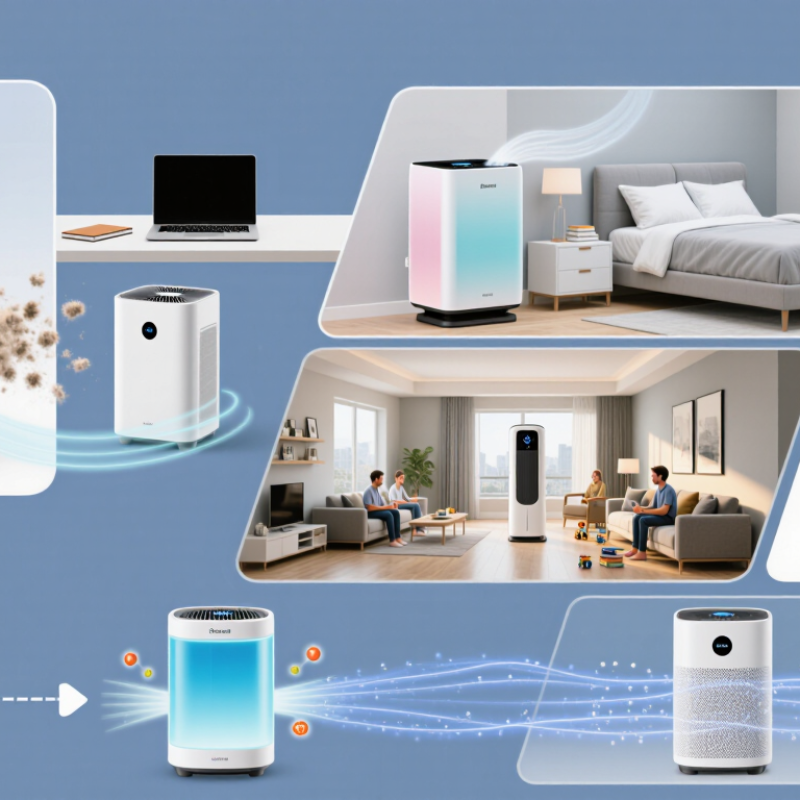
Top Air Cleaner Types for Every Need?

Mechanical HEPA Filters: 99.97% Capture at 0.3 Microns (U.S. DOE)

Mechanical HEPA filters trap airborne particles in a dense web of fibers. They do not work like a simple screen. The U.S. Department of Energy benchmark is 99.97% capture at 0.3 microns under specified test conditions. That figure matters. It describes filter performance, not the cleanliness of an entire room.

Room results depend on more than the filter. Air must pass through it, so a well-sealed housing helps prevent bypass. Match the cleaner’s airflow capacity to the room, and consider where people spend time. A unit tucked behind a chair may circulate air less effectively. The 0.3-micron figure can also be misleading: it is a test reference, not a promise that every particle in every home will be removed at that rate.

Maintenance counts. Dust buildup can restrict airflow, while a damaged or poorly fitted filter may let particles escape. Check the filter according to its instructions and replace it when needed. HEPA media captures particles, but it does not necessarily remove gases or odors; those may require a separate sorbent filter. A percentage alone is easy to admire. It is less useful without good airflow and a snug fit.

Mechanical HEPA Filters: 99.97% Capture at 0.3 Microns

The U.S. Department of Energy HEPA benchmark is at least 99.97% particle removal at 0.3 microns. Real-world performance can vary with filter condition, fit, and air leakage.

Activated Carbon Cleaners: Adsorbing Gases and Odors

Activated carbon cleaners target gases and odors, not just visible dust. Their porous carbon surface holds many odor-causing and volatile compounds through adsorption.

Think cooking smells lingering near a stove, or solvent-like odors after painting. The carbon’s mass and contact time matter: a thin carbon-coated sheet may capture less than a deep carbon bed.

EPA’s The Inside Story: A Guide to Indoor Air Quality reports that concentrations of some indoor pollutants are often 2–5 times outdoor levels, and can occasionally exceed them by over 100 times.

The gap can be striking. These figures describe certain pollutants and situations, not every home.

When choosing a unit, check whether its documentation identifies gas-removal testing, rather than relying on a particle CADR rating alone. ASHRAE Standard 145.2 provides a laboratory method for evaluating gas-phase air-cleaning devices; real-room performance can differ with airflow, pollutant mix, and use.

Carbon also has limited capacity. A fading odor-control effect may mean the media is saturated, even if the fan still runs. Humidity can affect adsorption, too.

One limitation deserves a second look: odor reduction does not prove every harmful gas has been removed. Pair filtration with source control and ventilation where practical, and follow the maker’s replacement guidance.

Electrostatic and Ionizing Cleaners: CARB’s 0.050 ppm Ozone Limit

Electrostatic and ionizing air cleaners can reduce airborne particles by charging them, then attracting them to collection plates or surfaces. Some models may also produce ozone as a by-product. Ozone has a sharp, clean-like smell, but that smell is not proof of clean air. It can irritate the lungs, especially for people with asthma or other respiratory sensitivities.

CARB sets a 0.050 parts-per-million ozone emission limit for covered indoor air-cleaning devices under its prescribed test conditions. That limit is useful when comparing products. It does not mean every room will have exactly that ozone level, or that the device removes every pollutant. Check current CARB certification for the specific model, and follow its operating and maintenance instructions. A dirty collection plate can weaken particle removal. There is a catch.

Room size and ventilation matter, too. A small bedroom with closed windows is different from a large, ventilated living area. If ozone concerns you, consider a mechanical filter that does not intentionally generate ozone. Keep expectations realistic: air cleaners cannot replace source control, such as reducing smoke or dust. The number helps, but it is not a comfort blanket. I would still weigh the device’s cleaning performance, upkeep, and the needs of people in the room.

UVGI Air Cleaners: How Germicidal Performance Depends on Exposure

UVGI air cleaners use ultraviolet germicidal energy, usually UV-C, to damage microbes as air passes through a treated zone. Their performance depends on dose: the light intensity received over time. A fast-moving airstream may allow little exposure. Slower flow can help, but only when the unit is designed for it. Time matters.

Dose isn’t the only factor. Lamp output can decline with age, while dust on a lamp or reflective surface can reduce the light reaching microbes. Airflow paths matter too: air that bypasses the UV chamber receives little treatment. Humidity and the type of microorganism may also affect susceptibility. Not just intensity. A result from one test cannot describe every room, and a number on a product sheet needs context.

When comparing units, look for stated airflow and validated reduction data, not wattage alone. Check whether testing used conditions similar to your expected settings. Maintenance counts: follow cleaning and replacement instructions, even when the lamp still glows. UVGI can complement filtration, but it does not remove particles or odors by itself. I would avoid calling any unit a room sterilizer. Enclosed systems should prevent direct UV exposure to eyes and skin; visible light does not prove harmful UV is absent. Real-world performance is less tidy than a lab chart.

Room-Size Selection: AHAM’s Smoke CADR Rule of Two-Thirds

For room-size selection, AHAM’s rule of two-thirds offers a practical starting point: choose an air cleaner with a smoke CADR at least two-thirds of the room’s floor area in square feet. AHAM’s guidance assumes an eight-foot ceiling. A 300-square-foot bedroom, for example, calls for a smoke CADR of about 200 cubic feet per minute. That is the baseline. The rating comes from standardized testing, including the ANSI/AHAM AC-1 method, rather than a guess based on the unit’s appearance.

Smoke CADR is useful because it reflects the removal of small particles. The U.S. Environmental Protection Agency also advises matching an air cleaner’s CADR to the room size and notes that CADR ratings apply to particles, not gases. Check the actual room, not just the home’s listed square footage. A high ceiling, an open doorway, or frequent cooking can make the two-thirds estimate less reliable. In those cases, a higher CADR may help, though it can mean more noise at faster settings. The rule is not perfect. Measure the space, compare the smoke rating, and consider whether the cleaner can run comfortably where people sleep or work.

Top Air Cleaner Types for Every Need? — Room-Size Selection: AHAM’s Smoke CADR Rule of Two-Thirds

For rooms with 8-foot ceilings, select an air cleaner with a smoke Clean Air Delivery Rate (CADR), measured in cubic feet per minute (cfm), of at least two-thirds of the room’s floor area in square feet.

Typical Need Room Area Minimum Smoke CADR Suitable Air Cleaner Type Selection Guidance
Small bedroom or home office 150 sq ft 100 cfm Mechanical particle filter, such as a HEPA-filter air cleaner Check that the smoke CADR meets the room-size target at the fan setting you expect to use.
Medium bedroom or study 225 sq ft 150 cfm Mechanical particle filter; an activated-carbon stage may be added for some odors Particle filtration and odor removal are different functions. Carbon performance depends on the amount and design of the carbon media.
Typical living room 300 sq ft 200 cfm Mechanical particle filter with a smoke CADR suited to the space Use the smoke CADR when estimating performance against smoke-sized particles; do not substitute a room-size claim for a CADR value.
Large living room or open-plan area 450 sq ft 300 cfm Higher-capacity mechanical particle filter; optional activated carbon for selected gases and odors For open layouts, include the connected area that the cleaner is expected to serve.
Large open-plan room 600 sq ft 400 cfm High-capacity mechanical particle filter, or multiple appropriately sized units Two or more units can be considered when one unit cannot provide the required CADR or air does not circulate evenly.
Odor-focused use Use the room-area row above Use the room-area target above for particles Particle filter combined with an activated-carbon filter Smoke CADR measures particle-cleaning performance, not general gas or odor removal. There is no equivalent universal CADR for all gases.

Room-size rule: Minimum smoke CADR (cfm) = room area (sq ft) × 2/3, assuming an 8-foot ceiling. For ceilings higher than 8 feet, consider a larger capacity in proportion to the additional room volume. CADR is a particle-cleaning rating; it does not by itself indicate removal of gases or odors.